
Alina Sokolenko | The ‘Green’ Transition Hinges on Staff: How Ukraine Can Avoid Missing Its Chance for a ‘Green’ Revolution
-
 Reading time: 6 min
“Green” professions are becoming the norm for business, but the Ukrainian labour market faces challenges: a lack of qualifications, weak educational infrastructure and global competition. Are Ukrainians ready for the demands of the “green transition,” and what should companies and the state do about it? Alina Sokolenko discusses this — a Forbes contributor and head of the Association of Sustainable Development Experts (ASDE).
— Why has sustainable development become the new norm for business, and what does this mean for Ukrainian companies?
— Sustainable development is becoming the new norm, and the introduction of Corporate Sustainability Reporting Directive (CSRD) standards and the EU’s “Green Deal” requires Ukrainian companies to adapt and creates high demand for sustainable development specialists. The question is whether the Ukrainian labour market can keep pace with the “green” transition.
— How acute is the shortage of “green” skills and staff in Ukraine already?
— Only 13% of workers in Ukraine have the necessary skills, and 82% of companies cannot find suitable specialists — this is shown by the results of the “Work That Changes the World” study, conducted by ASDE together with the Ministry of Environmental Protection.
— What global labour-market trends are boosting demand for “green” competencies?
— The global labour market is changing under the influence of climate and social challenges. By 2030, adaptation to climate change will provide around 5 million new jobs, another 3 million will emerge in responding to climate risks, and more than 1 million in the sector of new energy technologies, the World Economic Forum forecasts. This means the emergence of professions of a new kind: renewable energy engineers, ESG analysts, sustainable development managers, and experts in biodiversity and the circular economy. These specialisations are no longer exotic, but the norm for a competitive business.
— Is the number of “green” vacancies really growing, and what is preventing Ukraine from taking advantage of this trend?
— The number of “green” vacancies has grown by 116% over the past five years, according to data from the Indeed platform. Ukraine is also showing dynamics in the growth of such vacancies on the labour market: this is confirmed by the steady increase in their number on the platforms Happy Monday, Work.ua, GRC.ua and Robota.ua. However, this growth runs up against a systemic obstacle — the lack of quality educational infrastructure for training the relevant specialists.
— What is the key institutional problem for the sustainable development specialist profession?
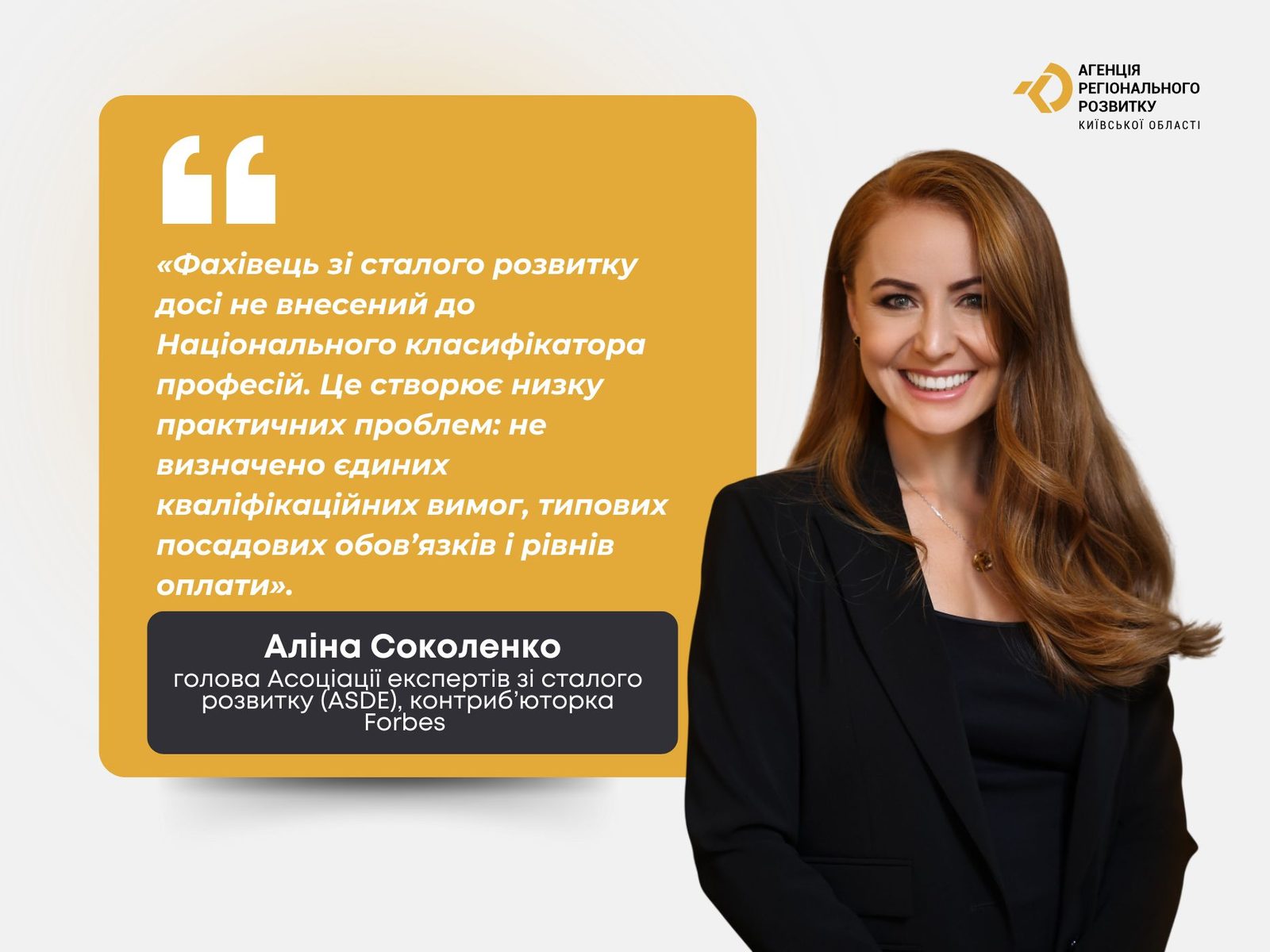
— The sustainable development specialist has still not been included in the National Classifier of Professions. This creates a number of practical problems: there are no unified qualification requirements, standard job duties or pay levels. Employers are forced to “invent” the employee’s role themselves, while the latter have to adapt to inconsistent expectations, which creates a fragmented and unequal market.
— How do greenwashing and greenhushing affect the development of this field?
— All sectors of the economy face greenwashing and greenhushing — practices that distort the real picture of ESG efforts. Imitating a responsible approach or, conversely, understating achievements, undermines the trust of investors, society and regulators, slows real transformation, and holds back institutional recognition of the sustainable development specialist profession. In the context of Ukraine’s European integration course, where transparency and accountability are becoming mandatory requirements, this is no longer just an ethical but also a strategic threat to business.
— Is there positive momentum: how are companies building sustainable development, and what positions are emerging on the market?
— There is positive momentum. Companies are integrating sustainable development into their strategies, not just into PR reports — this is shown by the results of the study “ESG Reporting: Analysis of Disclosure Practices” by the Green Transition Office at the Ministry of Economy. Abroad, the number of top-management positions is growing, including Chief Sustainability Officer, who are responsible for implementing ESG goals at the business-model level, confirmed by the number of vacancies on career portals such as CSR Jobs, Jobs That Make Sense, Enable Green and Green Career Hubs. In Ukraine, the highest positions in sustainable development currently are heads of sustainable development divisions or departments, such as at Ukrgasbank, Ukrhydroenergo, MHP, Kernel, Nibulon and others. 64% of employees in the sustainable development field are women, according to data from The State of the Sustainability Profession 2024 study. This field is one of the most gender-balanced, including in Ukraine.
— Where exactly is education failing to keep up with the labour market?
— The key challenge remains the gap between educational content and market needs. Employers expect sustainable development specialists to have project management skills (78.4%), analytical thinking (74.3%), strategic skills (59.5%), as well as communication flexibility and adaptability — over 80%, according to the results of an ASDE study. Universities are not currently forming these competencies systematically.
— What regulatory and financial changes are increasing requirements for ESG competencies?
— The National Bank of Ukraine has published a White Paper on managing environmental, social and governance (ESG) risks in the financial sector, which envisages integrating ESG risks into banks’ decision-making process. Requirements for non-financial reporting, climate-risk assessment, gender-equality analysis, human rights and social impact are gradually increasing. The “5-7-9” lending programme and other state financial instruments are also increasingly oriented towards environmental and social criteria, and partner financial institutions are beginning to require borrowers to observe basic sustainable development principles. International investors and donors are tightening their requirements: IFC, EBRD, KfW, Finnfund, NEFCO and others include environmental and social risks among mandatory project-selection criteria even in the private sector. This means that businesses that do not know how to manage their impact will not gain access to capital, and over the next three to five years this trend will only intensify.
— What steps need to be taken right now so that the market does not remain fragmented?— So that these problems do not turn into a tangle that will be hard to unravel, a number of measures need to be taken right now: include “green” professions, such as “sustainable development specialist,” in the National Classifier of Professions and establish unified qualification requirements for them; develop educational programmes that meet the current demands of the labour market, and integrate sustainable development into the strategies of Ukrainian universities; strengthen the state’s role in creating a stable and up-to-date system for training staff for “green” professions. In this reality, business needs to think not only about strategy, but also about mindset. Because sustainable development does not start with a company’s policy, but with how its leader sees their place in the world.