
Conversation with Yuliia Korniichuk: Accounting, Finance and Strategy. How Kyiv Oblast Entrepreneurs Can Build Business Systematically
-
 Reading time: 11 min
A modern accountant has long been more than just someone who keeps records and calculates taxes. Today, they are a financial partner for business, helping entrepreneurs make strategic decisions, build processes and scale companies even in the difficult conditions of wartime.
ARRKO spoke with Yuliia Korniichuk — Head of Accounting at the international company Pharmbills, founder of the accounting and analytics company K&K, a member of the Board of Founders of GOODWILL.Club and a two-time member of the TOP-10 Accountants of Ukraine rating. We talked about the transformation of the accounting profession, entrepreneurs’ typical mistakes, the challenges facing business during the war, and why systematisation has become a key condition for the development of any venture.
— Yuliia, you have 17 years of experience and have twice made the TOP-10 Accountants of Ukraine list. How has the role of an accountant changed over this time: is it still someone who calculates taxes, or already a fully fledged financial strategist for business?
Over my many years of experience, the role of the accountant has changed significantly. I remember the beginning of my journey in the profession: thanks to my grandmother, I chose this line of work because I saw how interestingly she calculated on an abacus. By the time I entered the profession, abacuses were already gone — there were computers and accounting software, but at the same time there was still a lot of paperwork and routine operations.
What do we see now? First, the profession is changing under the influence of technology: artificial intelligence is already helping accountants with routine operations. Second, business needs are changing. Today entrepreneurs expect from an accountant not only purely accounting functions — timely and correctly submitted reporting, correctly prepared primary documents, business transactions reflected in reporting — but also partnership in analysing figures and planning the next steps in financial management.
In other words, we now see a symbiosis of the roles of accountant and financial manager, which business needs. To sum up: the profession is changing significantly, and thanks to technology and entrepreneurs’ demands, these changes are happening even faster than 10 years ago. This requires qualified staff who are constantly learning and flexibly adapting to new technologies.
— You hold the position of Head of Accounting at Pharmbills. Working at such a large-scale company requires systematisation. Which principles of large corporate accounting would you recommend that small entrepreneurs in Kyiv Oblast borrow?
The first thing I really like within a large international company is an understanding of processes. And that is exactly what should also exist in microbusiness. When a business owner starts out, they need to clearly understand which roles they perform. Because within each role — whether it’s the business owner, the HR department responsible for hiring and training staff, or the finance department and accounting — there are functions and tasks assigned to each of them.
Why is this important? If at the start of building a business the owner does not understand these roles, it will later be very difficult to delegate them and retain their main role — strategic management. So describing processes and understanding roles is the most valuable thing I would recommend small entrepreneurs in Kyiv Oblast borrow. And based on these roles, instructions should be written for each function: what the final valuable product of each role is. Then, first, such a system can be managed, and most importantly, such a business can be scaled.
— You are a member of the Board of Founders of GOODWILL.Club. Why is it important for a modern specialist to be part of a professional community rather than working “in isolation”?
A very good question. On the one hand, we are living in an era of huge technological change: artificial intelligence can advise on a great deal. But my personal opinion is that it is precisely at this time that the value of human communication becomes more significant than ever. And this is not just communication, but communication within a circle of professionals.
If we work alone, we cannot even effectively analyse a particular step we take. In a community, however, when we share various work situations and cases, on the one hand we find solutions, and on the other we learn from one another.
That is why we are now seeing the emergence of many professional communities, and accounting is no exception. The GOODWILL.Club community, of whose Board of Founders I am a member, is indeed a community of professionals, of practising accountants. This is important because, in my opinion, knowledge without practice equals ignorance. I recommend colleagues join our community — all the details can be found via the link on our Instagram.
— Many people start their own business “from scratch, informally.” In your opinion, what is the most critical mistake in preparing documents that can cost a business its reputation or heavy fines?
The most critical mistake is failing to understand the process. If we are talking about a document, you need to know which details it must contain. On the one hand, we now have a huge amount of information available: YouTube, TikTok, various forums, artificial intelligence that can offer advice. But without basic knowledge, critical mistakes are sometimes made.
Let me give an example. Failing to check the taxpayer’s account when registering as a sole proprietor, when there is arrears on any tax, led to fines from the tax authorities of over 100,000 hryvnias for one of my clients who registered as a sole proprietor on their own. For me, as an accountant, this is already an automatic step built into the process. It is understandable that a person registering on their own may simply not know this, and the materials they reviewed will not mention it. After all, as in any profession, the level of qualification among accountants today varies greatly.
So, however simple this process may seem to you, I recommend: even if you decide to keep your own tax or accounting records at first, be sure to find a specialist and get at least a consultation.
— KVEDs, sole proprietorships, LLCs — for many this sounds like a foreign language. Is there a universal formula for choosing a legal form, or is it always an individual story?
I would like to say that such a formula exists, but in fact it does not. It really is an individual story. A great many entrepreneurs come to me with this question, and only after a series of questions and answers do we manage to work out which registration and ownership form is most optimal.
Why is that? To answer this question, you need to see what prospects the entrepreneur envisions for the coming year and the following two years, what type of activity they wish to pursue, exactly what they plan to do, and how things stand with hired employees. In other words, an enormous number of factors influence the choice of business form at registration.
How to decide? I recommend contacting a specialist for at least a consultation. You can choose the KVEDs (economic activity codes) yourself in advance, but from my own experience I see that even when a client comes with a certain list of KVEDs, during the consultation it turns out that some need to be added and some removed, because they may contradict the chosen taxation system. There are many nuances, so there is no universal formula here.
— You specialise in accounting outstaffing. Should a novice entrepreneur try to keep records independently through “Diia,” or is it better to delegate this to professionals right away?
My opinion is this: it is possible to keep records independently, but there are several significant nuances. First of all — who can keep records independently? These are sole proprietors who have no hired employees. For example, an IT specialist providing services: here the number of business transactions is minimal. You can get a consultation — there are also YouTube channels, such as the channel of Mykhailo Smakovych, where information is constantly updated. At one point I even recorded a course called “Be Your Own Accountant,” but then I realised that a lot can change over the course of a year — both tax rates and tax reporting forms. Such information loses relevance very quickly.
If we are talking about manufacturing business activity that involves hired employees and the use of a cash register (PRRO), here I already recommend turning to specialists. Let me explain. If the owner spends most of their time on accounting functions, the question arises: when will they perform their functions as the business owner? And these functions cannot be delegated, especially at the start — this is their main role.
So it is better for business owners to focus on what actually generates income, while a specialist helps with accounting matters. When looking for a specialist, I always advise paying attention to recommendations: on the one hand it may seem that there are many specialists, but on the other, the quality of most of them, unfortunately, raises doubts.
— Legal cleanliness of business during the war: what are the tax authorities paying the most attention to right now?
From what we see within microbusiness: if it really is microbusiness, then the most common form of registering business activity today is a sole proprietorship. And if everything is correct with tax accounting — reporting is submitted on time and correctly prepared, taxes are paid on time, a software cash register (PRRO) is used when necessary — then, frankly, I have not seen any high-profile cases or claims from the tax authorities in this segment.
If we are talking about large business and the use of fragmentation schemes — when a large business is represented not as a single LLC generating all financial and business transactions, but as one LLC and a great many sole proprietors — such businesses are under the tax authorities’ sights for tax audits.
You always need to look at the situation in more detail, not just based on the news. I personally do not work with clients who insist on using such schemes. After all, both the tax authorities and we as entrepreneurs are becoming digitalised now. The tax authorities have the ability, through the electronic VAT accounting system, to see and check such schemes.
— How do you personally maintain your qualifications? After all, Ukrainian legislation changes almost every week — where do you get verified information?
One of the main secrets of my success in the profession and in maintaining my expertise is, of course, being part of the professional community GOODWILL.Club. Within the community, in our communication, including in our Telegram chats, I can always keep my finger on the pulse of changes.
In addition, I am subscribed to many professional publications — for example, “Yuteka” — and I constantly analyse information relevant to my clients’ businesses. As you rightly noted, with such a huge number of changes it is very important to respond to them in a timely manner, and also to know how a particular legislative provision can be applied for the benefit of clients’ businesses.
— What three main pieces of advice would you give to residents of Kyiv Oblast who are currently hesitating whether to open their own business or wait for “better times”?
I generally hold the view that life is exactly what is happening to us right now, and while waiting you can really miss your moment. So, if there is a desire, I would advise starting your own business: when we act, we gain experience. However brilliant something may sound on paper, if no concrete steps are taken, it will remain on paper and bring no experience.
At the same time, very simple tools — such as a business strategy written down even in your own words, and a business plan filled in in Excel (a plan of income and expenses for the year) — will help you look at the situation through a system of values and through planned financial data, and see possible pitfalls. This will allow you to make decisions based on certain calculations, rather than solely on thoughts that are not written down or quantified anywhere.
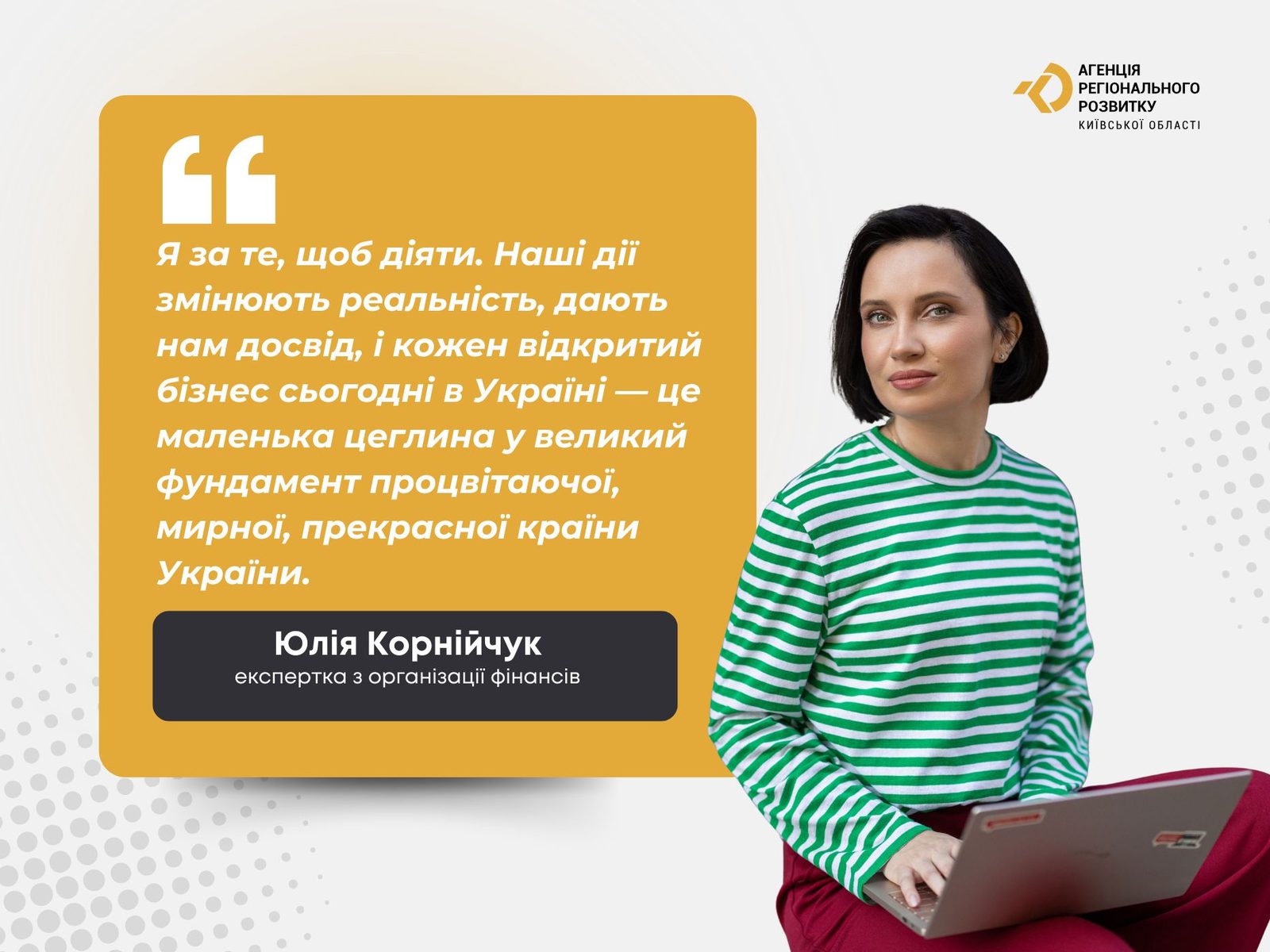
So I am in favour of taking action. Our actions change reality, give us experience, and every business opened today in Ukraine is a small brick in the great foundation of a prosperous, peaceful, beautiful Ukraine.