
Fundraising as institutional capacity: what Kyiv region’s communities need in 2025
-
 Reading time: 6 min
In 2025, communities can no longer afford to act in a fragmented manner — donors expect consistency, clear priorities and the ability to implement projects at a high level.
Fundraising is therefore ceasing to be merely a “search for grants” — it is becoming a tool for strategic development, reputational growth and the building of partnerships for years to come.
What should be a community's first steps? What do donors expect? How can we build an ecosystem that strengthens not only the budget, but also the reputation?
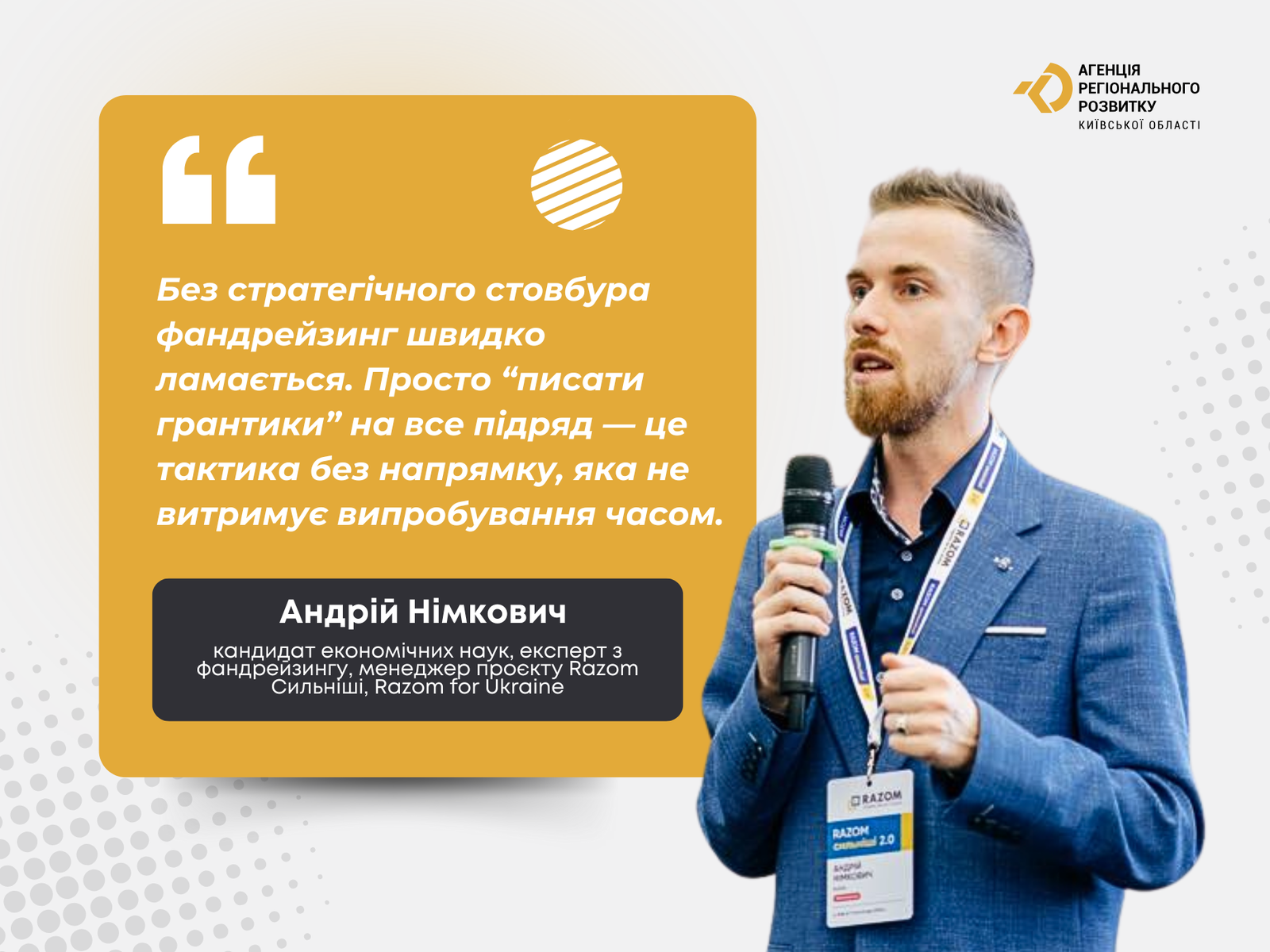
This is the subject of an interview with Andrii Nimkovych, PhD in Economics, fundraising expert and project manager at Razom Together Stronger, Razom for Ukraine, in a partnership piece for the Kyiv Regional Development Agency.
Where should communities that want to build a fundraising system start? Is it enough simply to have a "person responsible for grants"?
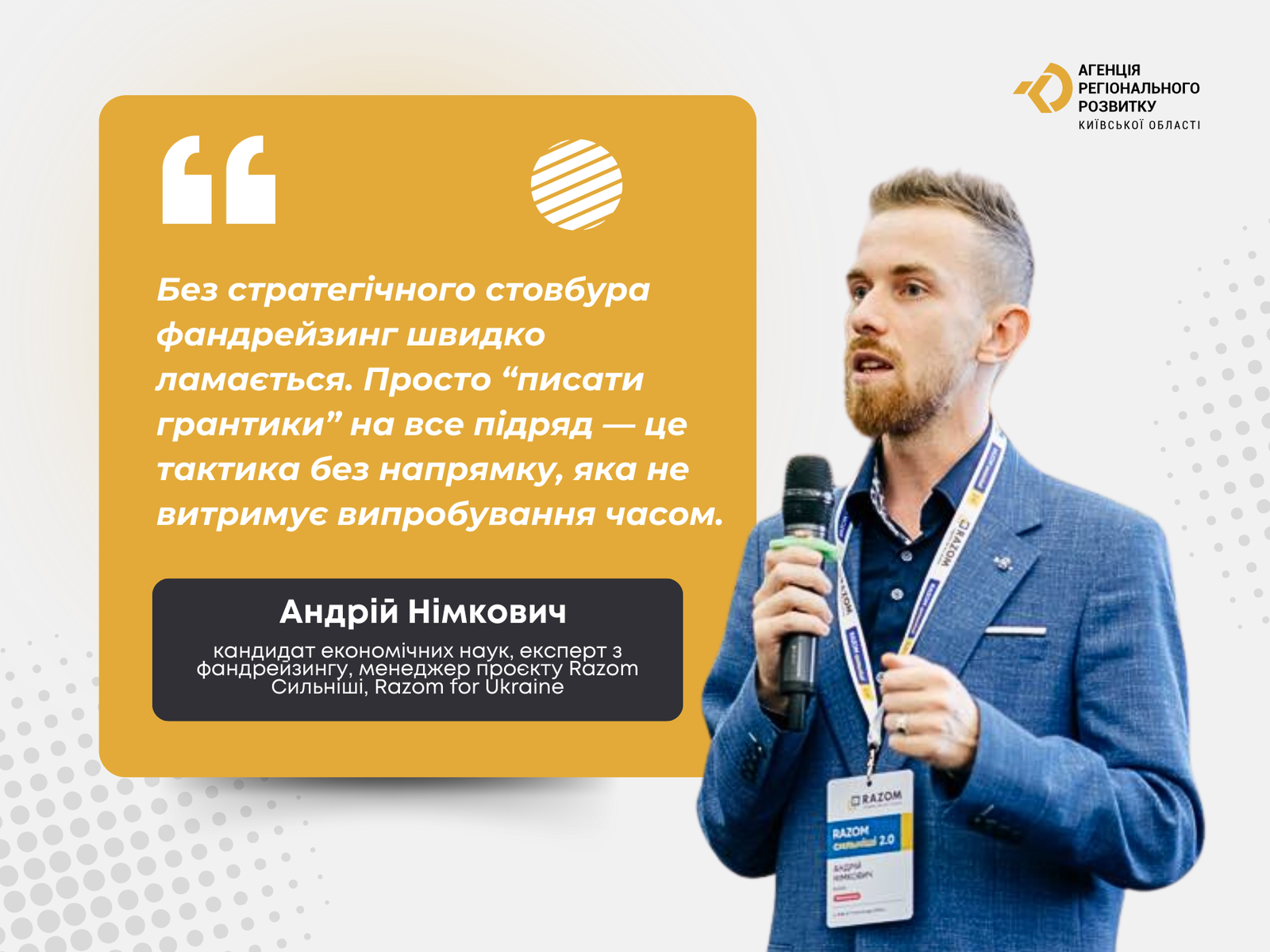
You should start with a strategy. Without a clear understanding of exactly what goals we need funds for, fundraising turns into a chaotic chase after grants. First, we define the community's strategic priorities, then the potential fundraising audiences: institutional donors, business, private individuals. Next, we analyse their motives for support: what matters to them, what values and goals they pursue, and how our community can logically "fit" into their logic of support. Because simply "writing grant applications" for everything in a row is a tactical level. And without a strategic core, it quickly breaks down. In my practice, there have been cases when we deliberately turned down large grants with a long implementation horizon because they did not match our strategy. And that was the right decision, which in the long run only strengthened the organisation.
What are the main difficulties Kyiv region's communities face in attracting resources?
First and foremost is the official status and "legibility" of the community as a partner. Donors always assess the relationship between local self-government bodies (LSGBs) and the civic sector. What often raises concern is either excessive "formalisation" on the part of the LSGB, or, conversely, the instability of initiatives. A team that acts on its own initiative and has a track record of implemented projects looks more reliable than one set up by an order "from above". The second typical obstacle is institutional capacity. It is not enough to have an idea — you need to show that there is a team, experience, processes, policies and financial control. Donors want confidence that the project will be implemented well and on time.
Which areas will be most relevant for Kyiv region in 2025?
In 2025, Kyiv region must not miss the opportunities linked to long-term development. This is not just about infrastructure recovery, but about the resilience and self-sufficiency of communities. The promising areas are: renewable energy, support for entrepreneurship, job creation, and social entrepreneurship — especially where social objectives are combined with business approaches. These are precisely the areas that international assistance is currently focused on.
Are there differences between fundraising for urban and rural amalgamated communities?
Yes, and these differences lie in the focus of donor attention. Small rural communities often have a better chance of support precisely because of their vulnerability: a limited budget, a shortage of staff, and remoteness from educational and financial centres. But weak institutional capacity can be a barrier. In this case, two approaches help:
- Demonstrate the individual capacity of participants, their experience and results in other organisations.
- Partnership with a more experienced community — a trend of 2025. A joint project application, where one community is the initiator and the other a mentor or technical partner, increases the chances of success.
How do you speak to donors "in their language"? What do they expect from communities?
First — quite literally — knowing English. This is no longer a "bonus", but a mandatory condition for effective communication, reading programme terms and taking part in international events. It opens doors to resources and partnerships. Secondly, "speaking their language" means: being fluent in key concepts such as impact, sustainability, relevance and multiplication; clearly setting out the budget and expected results; and showing the ratio of costs to impact. Donors want to see the logic: why this particular project, why this particular community, and why now.
How can you reach a systemic level of fundraising? Is that even realistic?
Not only realistic — it is already happening. There are examples of communities building a fundraising ecosystem: from project development to working with donors, business and citizens. What is needed for this:
- Establish a dedicated function or position responsible for resource mobilisation (fundraiser, partnerships manager, investment specialist — the title is secondary).
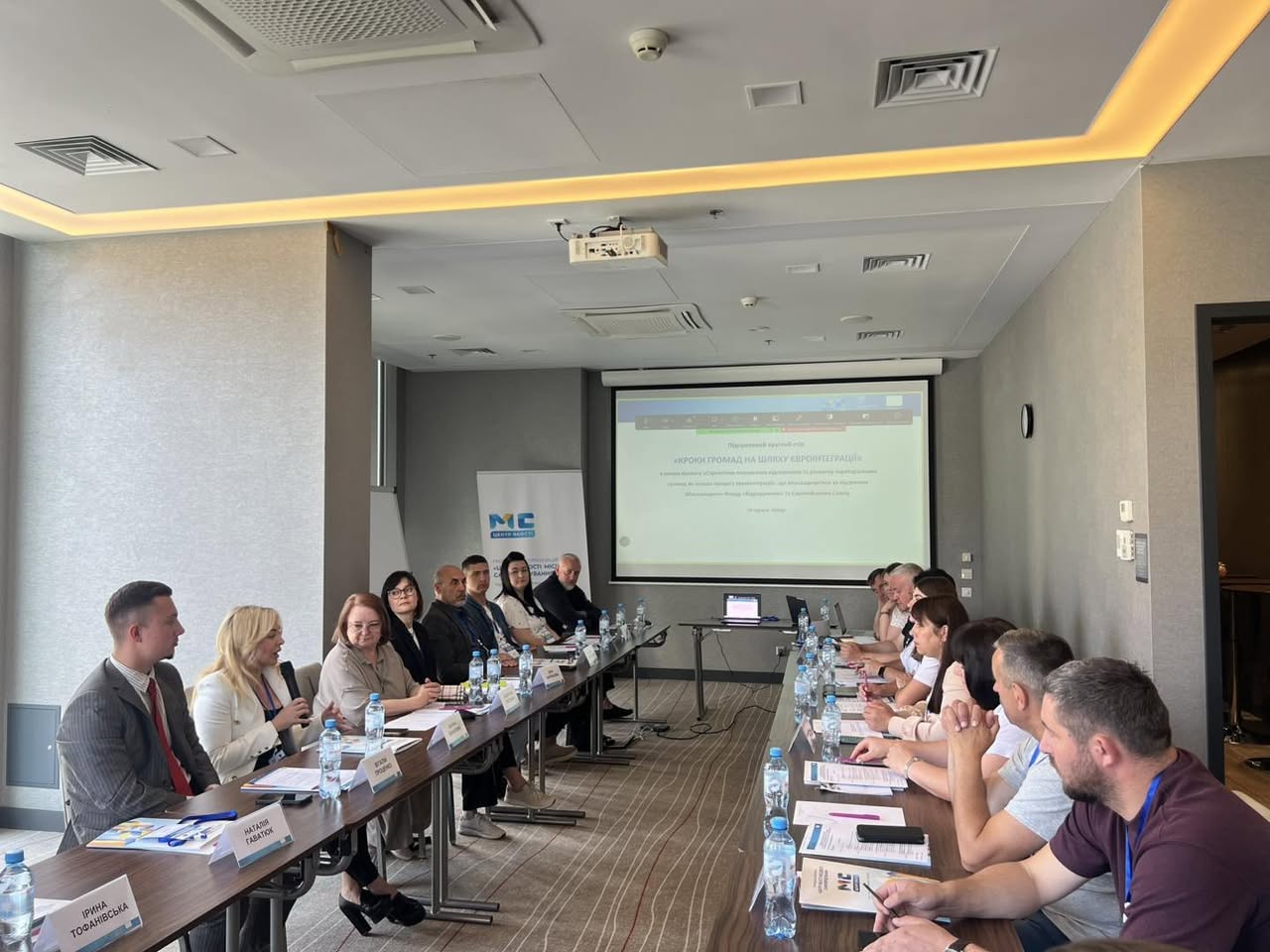
- An active external presence: forums, conferences, fairs, training — everything that builds the community's image as open, ambitious and capable.
- Integrating fundraising into the LSGB's strategy so that it is not a one-off activity, but a daily part of development.
Is there an example where fundraising strengthened not only the budget, but also the community's reputation?
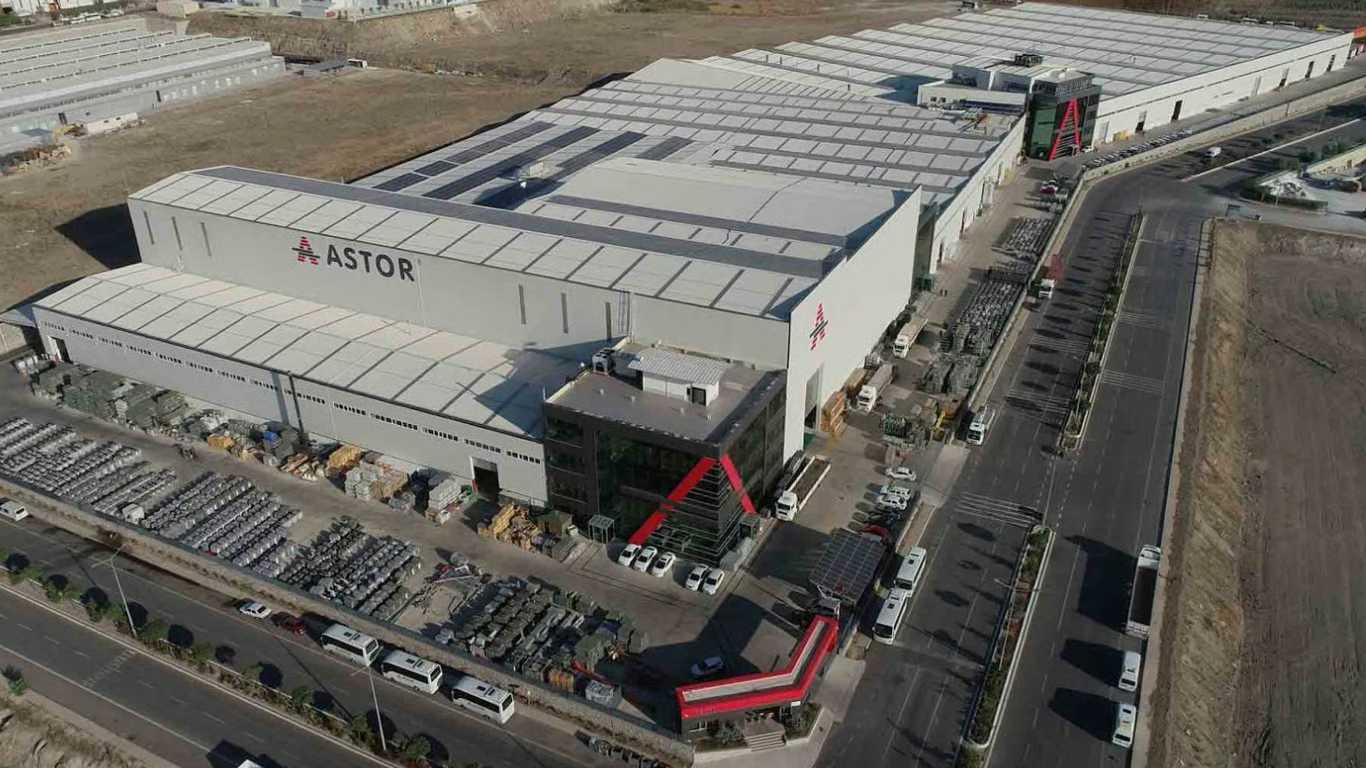
Yes. One case involved a community that had a large agribusiness on its territory. Thanks to effective communication with this business, it was possible to involve it in supporting local initiatives — in particular, play tables for children were installed and a youth space was set up.
Another example is when a community organised local fundraising and turned to local farmers who work and develop there. They supported the initiative to set up children's playgrounds. These stories brought not only financial support, but also significantly increased trust in the community, strengthened partnerships and brought people together around a common cause. The result was not only funds for project implementation, but also lasting connections and greater visibility for the community at the national level, invitations to national platforms and events, and participation in joint competitions for corporate social responsibility projects.