
Oleksandr Yavtushenko: from temporary assistance to systemic integration of IDPs in the communities of Kyiv Oblast
-
 Reading time: 9 min
The full-scale war has changed the structure of communities throughout the country — and especially in Kyiv Oblast. Today, internally displaced persons (IDPs) are not a temporary phenomenon, but part of a new reality that communities are learning to work with systematically. We talked about the challenges and solutions, about communities’ capacity for digital transformation, integration policy and cultural cohesion with Oleksandr Yavtushenko — head of the Council on IDP Affairs under the Kyiv Regional State Administration, Vice-President of the World Organisation of Displaced Persons.
What are the key challenges in the integration of internally displaced persons that communities of Kyiv Oblast face today? Can we already talk about a transition from emergency response to a long-term integration policy?
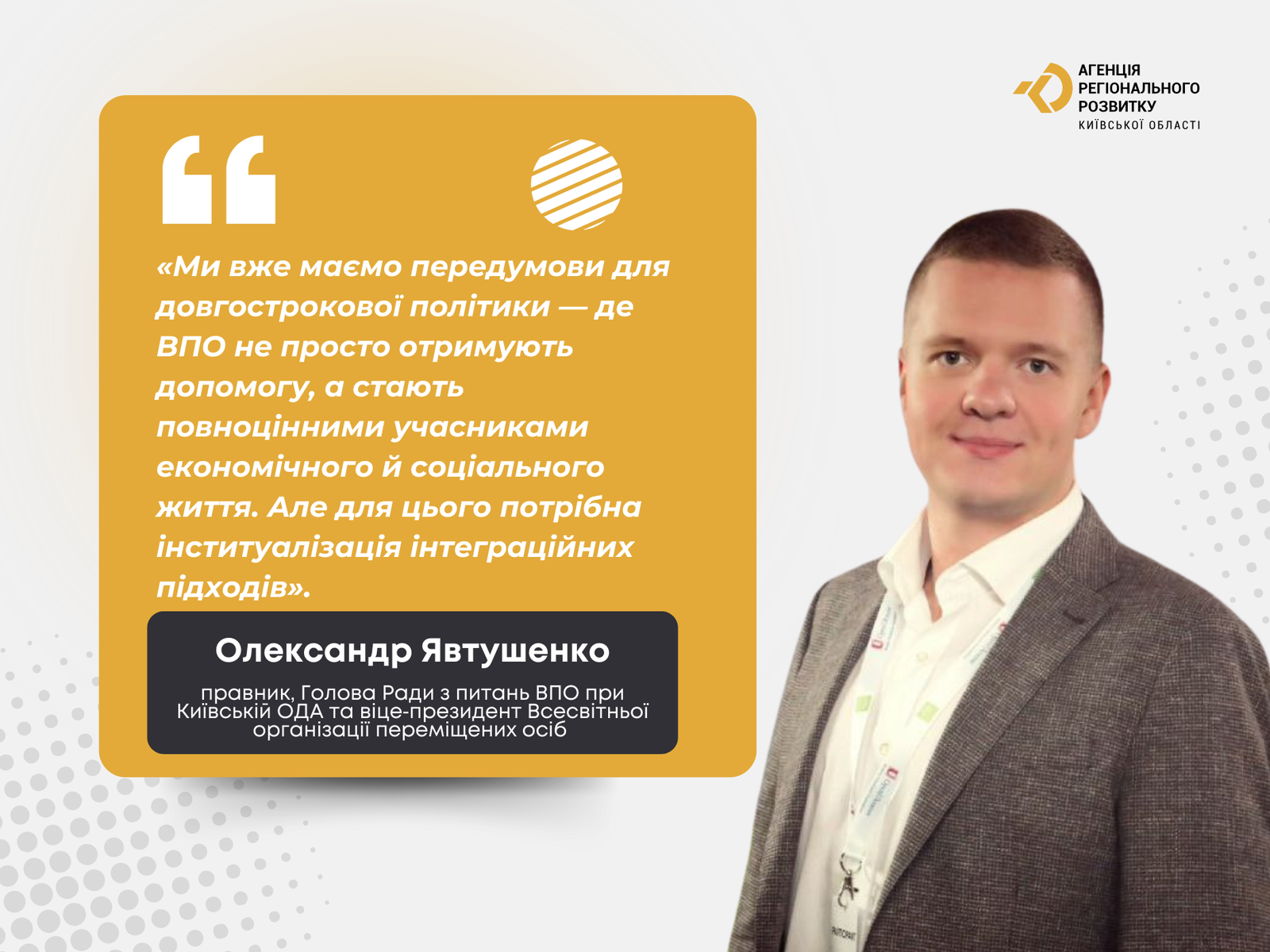
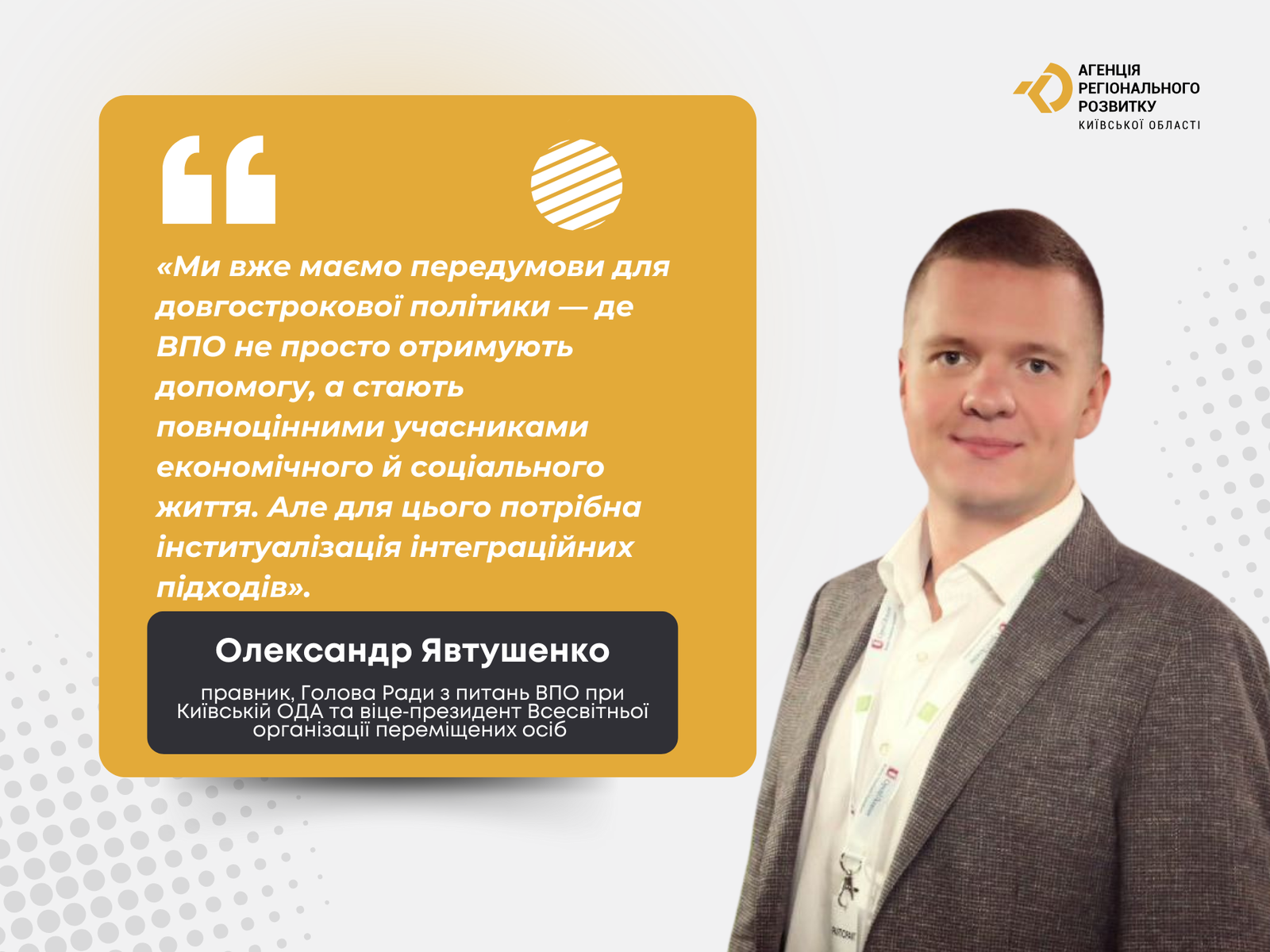
Today the main challenge for communities is the transition from "firefighting" to systemic integration. Some IDPs have been living in Kyiv Oblast for a third year already, yet they still remain in a state of temporariness — without stable housing, work, or a sense of inclusion in community life. Yes, we already have the prerequisites for moving to a long-term policy — where IDPs do not simply receive assistance but become full participants in economic and social life, but this requires the institutionalisation of integration approaches, not just project-based activity.
Housing and employment remain the main problems. The scale of the problem is so large that the state is unable to solve it alone. There are major imbalances both in the demand for labour of the relevant qualifications and in the supply of such labour. One of the key areas today is the retraining and requalification of displaced people so that they can find their place in the labour market of Kyiv Oblast and be able to independently earn money to improve their housing conditions. Another important area is cultural integration — as part of our "Knyzhkut" project, we have handed over more than 800 modern Ukrainian books to all 32 temporary accommodation centres (TACs) for displaced people in Kyiv Oblast.
How do you assess the capacity of Kyiv Oblast’s communities to develop and implement comprehensive IDP policies? What do they lack — resources, data, knowledge, or political will?
The situation varies from community to community. But in general, three things are lacking: first — quality and up-to-date analytical data (who exactly lives there, what needs they have, what the dynamics are); such data today can only be collected through sociological surveys (which need to be commissioned to be professional) and Big Data analytics (which telecom providers could provide, but that also costs money). At the same time, in 2024 we found partners with whom we conducted a large-scale analytical study among IDPs in temporary accommodation centres and presented the results to the regional leadership. Second — trained and motivated staff on the ground (the current level of pay for such specialists is simply humiliating and does not at all motivate an employee to invest emotionally in their work), and third — stable financial support. The political will is there, but without tools, methodological materials and regular training for local officials, it is difficult to reach a systemic level.
How can the communities of Kyiv Oblast strengthen resilience to information threats and cyber risks? Are there already cases where local self-government has shown an example of a successful response or countermeasure?
One of the most painful challenges is cyber fraud, which massively targets internally displaced persons, especially older people. IDPs often become targets for scammers: through fake messages in messengers or calls promising "new payments", "assistance from the UN" or a "status check". People, unfortunately, enter their banking details and lose money from their cards.
We run information campaigns, place warnings in communities, and create simple instructions — how to recognise scammers, where to turn. But the problem is that the desire to "get something quickly and without effort" runs too deep. And until there is systemic coverage, in particular through TV channels, Territorial Recruitment Centres (TCCs), and Administrative Service Centres (CNAPs), these cases will keep repeating.
Some communities are already responding promptly: blocking fake announcements, informing people through Viber groups and even through church communities. This works, but so far only in isolated cases. To improve cyber resilience systemically, it is necessary to involve not only IT specialists, but also those who are trusted by people — social workers, volunteers, local leaders.
Digitalisation at community level: where does it drive real change, and where does it turn into "paper digitalisation"? How should the real effect of digital solutions in municipal management be measured?
Digitalisation works where the logic of processes changes. If a community introduces a chatbot but still asks residents to "bring a certificate in person" — that is paper digitalisation. But if a resident submits an application online and receives a result without a visit — that is already a real transformation. The effectiveness of digital solutions should be measured not by the number of services introduced, but by the amount of time saved, user satisfaction, and the reduction of corruption risks.
What role does the public play in shaping security, digital and integration policies in the communities of Kyiv Oblast? Are residents, especially IDPs, ready to be not only recipients of services, but also active participants in local processes?
More and more IDPs are ready to get involved in decision-making, but for this they need to be given the conditions — access to information, the opportunity to speak up, a sense of security. Where advisory bodies exist under local self-government bodies — such as IDP councils — there are already examples of displaced people themselves initiating projects, helping vulnerable groups, and becoming ambassadors of change. The potential is there; the main thing is not to treat IDPs as "passive clients". It is also important to listen to IDPs not only when something needs to be done because an instruction has come from above, but to listen to them constantly, at a systemic level.
How can the communities of the oblast communicate effectively with IDPs — not only informing them, but also building trust, engagement and shared responsibility? Which formats work best — consultations, digital platforms, facilitated meetings?
A combination works — both digital tools and live interaction. Facilitated meetings in small groups are successful, especially in communities where there is a high level of distrust. It also works well when IDPs themselves become communicators — for example, in the role of advisors or mediators. Communication should not be one-directional but horizontal — with feedback, response, and a readiness to listen. In my opinion, the most successful IDP council in the oblast in this respect is in Bila Tserkva, where the IDP council does phenomenal things together with Oleksii Kudinov. But this is also thanks to the fact that it is a well-resourced and sensible community that understands that IDPs are a tool for joint action, not an extra burden.
What is the unique experience of Kyiv Oblast in working with IDPs that could be scaled up to other regions? Do we have grounds to talk about a "Kyiv Oblast model"?
Yes, I really do believe that we are gradually forming what can already be called the "Kyiv Oblast model" — and this is not a loud phrase, but the sum of daily practice, dialogue, mistakes and decisions that we have made together with communities.
Our uniqueness lies in a combination of several things. First, we placed a bet not only on humanitarian aid, but on the participation of displaced people themselves in decision-making processes. This includes both the creation of IDP councils in communities, and involvement in strategic planning, and cooperation with international organisations that heard us — because they saw that the communities were not just asking, but working.
Second, we have launched supported-living pilots — for example, in Borodianka and Pereiaslav, where people with disabilities can live not in institutions, but in ordinary housing with social support. This is very important, because we are essentially forming a new social philosophy — not about maintenance, but about living with dignity.
Third, we clearly understood: IDPs are not a burden. They are a resource. Among them are entrepreneurs, educators, volunteers, artists, IT specialists. And if a community cooperates with them, everyone benefits. We have seen displaced people create initiatives, open businesses, and become ambassadors of a new kind of integration.
And one more important detail — cultural integration. It was precisely in Kyiv Oblast that we implemented Ukraine’s first "Knyzhkut" project to set up Ukrainian-language book corners in places where IDPs are compactly settled. These are not just books — they are a symbol of openness to culture, an invitation to dialogue, and at the same time a very subtle but powerful step towards soft integration. A child who picks up a Ukrainian book in a city that is new to them is no longer a "displaced person" — they are part of the community. Today we are already scaling this project to Ivano-Frankivsk Oblast as well.
Yes, there is still a lot of work to do. But the approach itself is already there: shared responsibility, inclusion, mutual respect. And I am confident that if we preserve and strengthen this logic, Kyiv Oblast will indeed become an example for others. Not through slogans, but through results.
How do you see the transformation of the oblast’s digital infrastructure under conditions of war and post-war recovery? What should communities take into account in order not just to restore, but to rethink their digital ecosystem?
We have the opportunity not simply to rebuild, but to create a new digital ecosystem from scratch. This means — without duplicating paperwork, with transparent databases, with cyber protection as a standard, not a luxury. Communities must think not only about services for residents, but also about their own operational capacity: backups, stable communications, and trained IT specialists. Digitalisation should become not a project, but the fabric of everyday governance.