
Veterans’ voice in community strategy: interview with expert Anatolii Melnychuk
-
 Reading time: 8 min
How can we ensure that the needs of veterans, both men and women, do not remain merely on paper in social programmes, but become a foundation for the development of Kyiv Oblast?
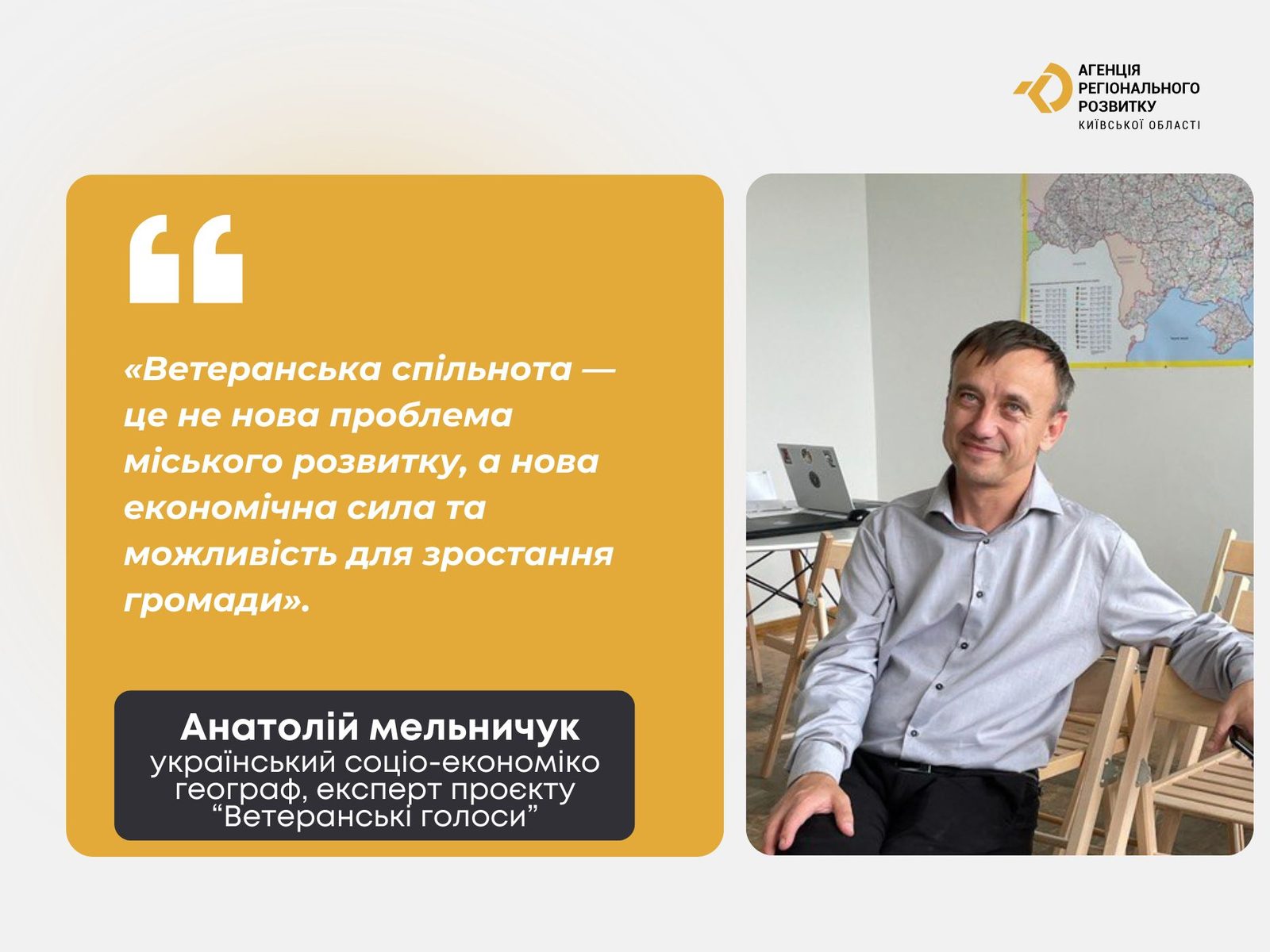
As part of the project «Veterans’ Voices: Taking Needs into Account in Community Strategies», implemented at the initiative of the Kyiv Regional Development Agency, we spoke with the project’s expert and focus-group facilitator — Anatolii Melnychuk.
The project is called “Veterans’ Voices.” Tell us, what is the main idea behind it? Why is it important for the veteran’s voice to be recorded specifically in the “Community Strategy,” rather than simply in a separate social programme?
The main idea of the project is to institutionally ensure the influence of veteran communities on determining the direction of the long-term development of territorial communities. A territorial community’s development strategy is the key document that determines the concentration of its efforts and resources on achieving long-term goals. It also means the channels, methods and tools planned for use. The war has aggravated the problems of local development in Ukraine. Individual problems form a complex knot. It is extremely important to find an effective algorithm for resolving it and to involve the population in the system of management decision-making. Community cohesion and the effectiveness of engagement in planning and other management tools are considered the best guarantee of the transition from planning to the implementation of specific measures and development projects. Small and vulnerable population groups, such as veterans, need more than just narrow social support programmes. They not only have problems that need to be solved, but also a strong voice and solutions capable of helping the community determine its development path and implement projects in various fields. Veterans often show leadership in the community in entrepreneurship, sport, patriotic education, the creative industry, law enforcement and many other activities. Therefore, without their position and participation, it is impossible to develop an effective territorial community strategy.
The Fastiv, Boiarka and Byshiv communities are involved in the study. Do they have something in common in their approaches to veterans’ policy, or is each community an absolutely unique case?
The communities were not selected to take part in the project by chance. Dialogue with veterans, both men and women, is a process that requires fine-tuning. Veteran spaces, discussions, programmes, events and tools, combined in various ways, determine differently the quality of use of the veteran community’s potential and support for specific veterans in these communities. After all, they have different resources for their development and different quality of staffing in local self-government and social welfare institutions. At the same time, these are communities that have already done significant work to ensure sustainable interaction with the veteran community, and are therefore more prepared to develop a formed, institutionalised and effective local policy in this area.
You conduct focus groups with very different audiences: from veterans themselves to local business and officials. Why such a wide range?
The purpose of holding focus groups is dialogue. It is, above all, a way to hear more and to coordinate one’s vision in conversation with a wide range of people interested in the community’s development. Politicians, officials, entrepreneurs, veterans, military personnel, and staff of institutions and organisations frankly and openly express their position on the complex issues of involving veterans in the life and activities of the community. They doubt, worry, debate, formulate ideas, and find common ground. The facilitator’s role is to lead a constructive discussion, shape positions and ideas that find the greatest consensus, and present them in the community’s public space.
What do you focus on during meetings in the communities (access to services, funding, the competence of the authorities)? Which of these currently sparks the liveliest discussions?
Facilitation involves a certain detachment from the life of a specific community, the absence of private interest and independence. Our role is to build an honest, meaningful dialogue, and to find agreed, constructive and balanced solutions and ways to achieve them. As a rule, the funding problem is the first to be seen and discussed. Resources and money are often viewed as the main way to solve all community tasks. But ultimately the dialogue always brings us to questions of respect, dignity, and the realisation of the values of democracy, freedom and choice. And we come to better understand that a veteran is a fundamental component in determining what the community will live for and by what means, on the path from recovery to integration into the European community of free-world communities.
The focus-group programme includes the involvement of entrepreneurs. What role does business play in communities’ veterans’ policy, based on your observations? Is it only about jobs, or something more?
The key issue that requires involving the veteran community in the planning process and the local-level decision-making system is the full integration of those who have returned from the front into community life. Economic integration is one of the main challenges in this process. Business plays two main roles here. First, it employs veterans and adapts corporate policies to their needs. Entrepreneurs get involved in the process of veterans’ integration — informing, hiring, consulting, and including them in networking. Second, veterans themselves become entrepreneurs — opening cafés, workshops, production facilities and farms, which can become deeply integrated into the local economy through procurement for schools, hospitals and other municipal institutions. This is not just reintegration, but also real economic support for the community. I want to emphasise two things here. First, the real economic component of veterans’ reintegration requires dialogue between them and business precisely within the planning process. A great deal depends here on coordination and consistency among many processes that the veteran community, business and the municipality cannot resolve on their own. Second, the veteran community is not a new urban development problem, not a “fifth wheel,” and not a small population group that only requires support. It is a new, including economic, force and an opportunity for achieving accelerated economic growth at the local level.
Do you sense a demand from veterans themselves and their families to influence community development? Do they trust such strategic tools?
Here, the veteran community is not unique with regard to a lack of trust. It exists among all stakeholders in the development of territorial communities in Ukraine. Trust needs to be built step by step. One thing is certain — without it, local development is impossible in principle. Constant dialogue, a transparent communication policy, involvement in consultations, and, most importantly, supported initiatives and joint action help break the ice of distrust and lead communities towards cohesion. Why is involving veterans in planning a new and unique opportunity for us? Because veterans are strong, do not back down in the face of difficulties, and have the vote of confidence of the majority of citizens. In my opinion, it is precisely they who now have the opportunity to influence community development, given constructive and coordinated involvement and activity. Whether our society will be able to take advantage of this is a question and a challenge of the current stage of its development.
Your task involves identifying a “competency deficit” among officials. Are local communities ready to admit that they lack the knowledge to work with veterans, and what kind of training do they need most?
We live in a time of constant change; new knowledge washes over society in waves and overflows the internet space. Artificial intelligence is already changing our lives — surgical operations, the planning and conduct of military operations, the development of new medicines, education, science are often ineffective without its involvement. Incompetence is not a fault, but a consequence of the need to adapt to change: a lack of experience, ready-made solutions, a system of staff training, and professional development. We are learning constantly, every minute. To work with veterans we need basic but modern knowledge in the field of correct communication, psychological support and interaction, legal support, engagement tools and others. Non-formal education is one of the pillars of the local economic development ecosystem. That is why we are not looking for someone to blame — we are looking for gaps that can and should be closed quickly. Our defenders deserve the efforts of all members of society to improve the convenience and comfort of their reintegration.
©️The project «Veterans’ Voices: Taking Needs into Account in Community Strategies» is being implemented by the NGO “From Village to City” in partnership with the Kyiv Regional Development Agency with the support of the “Enabling Civil Society for the Resilience and Recovery of Ukraine” programme (“Impulse Project”), implemented by the International Renaissance Foundation together with the East Europe Foundation, with the support of Norad and in partnership with Sida.
#ImpulseForNGO #VeteransVoices #KyivOblast #CommunityDevelopment #VeteransPolicy #EconomicResilience