
Viktoriia Protsenko. Capital Speaks the Language of Sustainability: How Ukraine Can Strengthen Investor Trust
-
 Reading time: 4 min
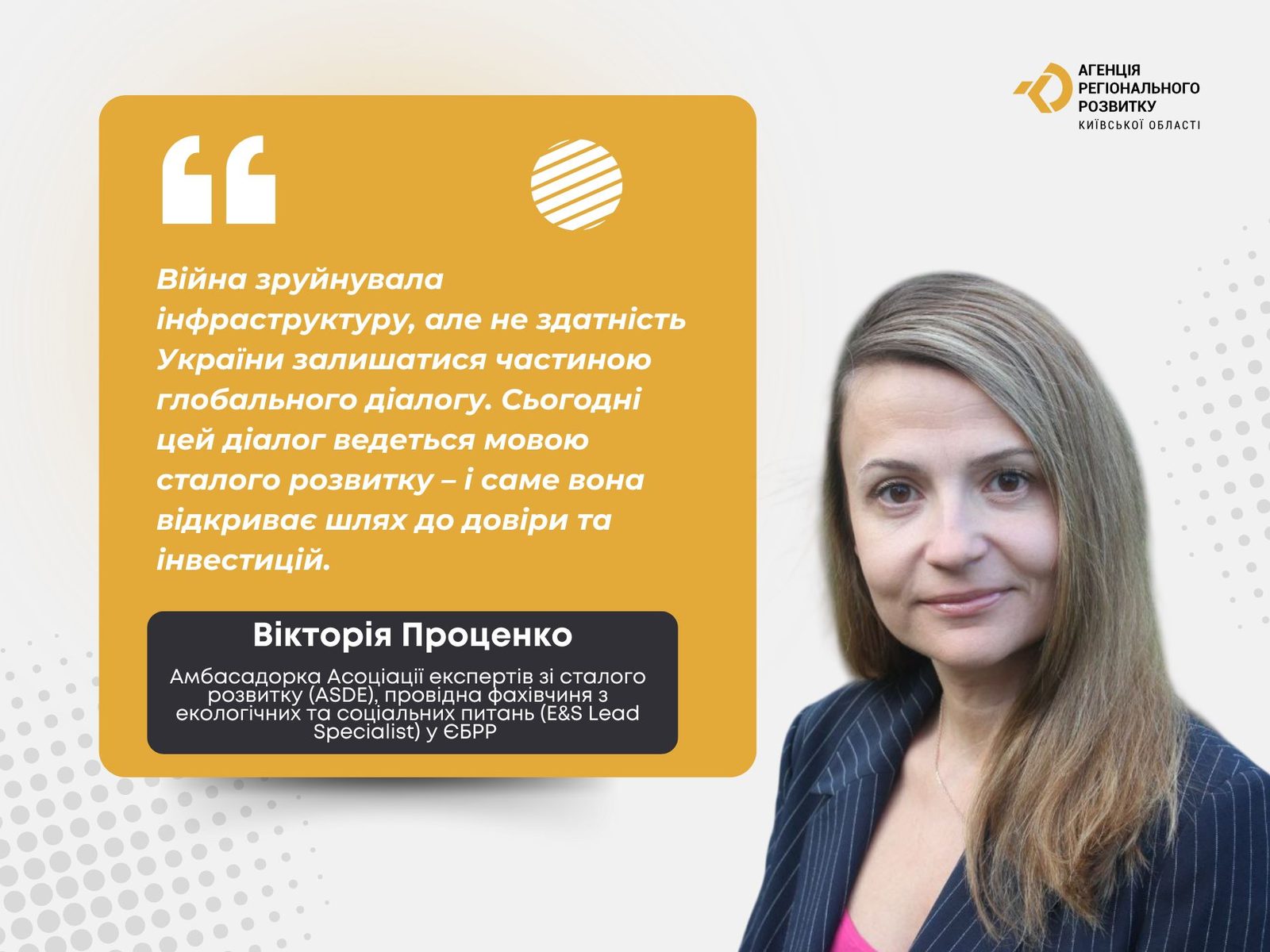
Viktoriia Protsenko — Ambassador of the Association of Sustainable Development Experts (ASDE), Environmental and Social Lead Specialist (E&S Lead Specialist) at the EBRD.
The Kyiv Regional Development Agency spoke with Viktoriia Protsenko — Ambassador of the Association of Sustainable Development Experts (ASDE) and Environmental and Social Lead Specialist (E&S Lead Specialist) at the European Bank for Reconstruction and Development. Why has sustainable development become the new language of global capital, how is the war changing investment logic, and what exactly can strengthen investor trust in Ukraine and its regions… Read all this and more in the interview.
Today there is a lot of talk about sustainable development as the key to investment. Is this really no longer a trend but a new norm for global capital?
Yes, it is already the norm. Just ten years ago, investors were primarily interested in financial indicators. Today, financial reporting is only the starting point. Capital moves to where there is trust, and trust is built through environmental responsibility, social resilience and quality of governance. These are exactly the factors that determine whether a country or company is seen as a long-term partner rather than a short-term opportunity.
Is there confirmation that sustainable development directly influences investment decisions?
Absolutely. According to Bloomberg, about 85% of portfolio investors expect further growth in assets related to sustainable development. The green bond market exceeded $600 billion in 2024, and in 2025 it is crossing the one-trillion mark for the first time. This means that ESG factors are already integrated into investment models, rather than existing separately from them.
How does Ukraine look in this global context, given the war?
The war, despite all its tragedy, has opened up a paradoxical window of opportunity for Ukraine. We are forced to act quickly, adaptively and according to new rules. Ukraine is demonstrating that even in extraordinary conditions it can build institutions, integrate into European markets and attract private capital. This is an extremely strong signal for investors.
What specific examples confirm this thesis?
There are several. First, the 2024 reform of corporate governance at state-owned companies is a direct step towards OECD standards. Second, the energy sector: synchronisation with ENTSO-E gave Ukraine the ability to trade electricity on the European market, and the target of 27% renewable energy by 2030 remains in place even after massive attacks. Third, so-called marker investments — for example, €450 million in the Tyligul wind power plant involving DTEK, EIFO and Vestas. This is the largest private investment under wartime conditions.
Isn’t the reduction in external support for Ukraine in 2025 holding investors back?
It is more that it changes the logic. The events of 2025 showed that external assistance cannot be the sole support. For Ukraine this means the need to create its own instruments — war-risk insurance funds, transparent regulatory mechanisms, and clear social standards. An investor is ready to take on risk if they see predictable rules and accountability on the part of the state.
You mentioned the social dimension. How important is it for the economy?
Critically important. According to international estimates, around a quarter of Ukrainians have symptoms of post-traumatic stress. This has a direct impact on productivity, the labour market and social stability. In addition, there is a growing risk of gender-based violence. For investors this is not a humanitarian abstraction, but a factor of economic risk. That is why social programmes, support for veterans, and policies on equality and mental health need to become part of Ukraine’s investment narrative.
Are there successful examples in the region to follow?
Yes, and they are very telling. Poland was the first country in the world to issue sovereign green bonds. The Baltic states are actively developing offshore wind power and energy storage systems. Georgia has created its own sustainable finance taxonomy, and Kazakhstan a regional green finance centre. All these countries prove that the size of an economy is not decisive if there is political will and transparent mechanisms.
What do you see as the main conclusion for Ukraine and regional development?
Ukraine has a chance to change its own role — from a country asking for help to a partner country. Our experience of war can become an argument for resilience rather than weakness. Reconstruction can be innovative, sustainability can be an economic advantage, and trust can be the main resource. Global capital already speaks this language. The next step is to make it organic for Ukrainian regions and projects.