
War and recovery: challenges and opportunities for the communities of Kyiv Oblast
-
 Reading time: 8 min
Can war become a catalyst for change? In the opinion of Anatolii Melnychuk, Associate Professor at the Department of Economic and Social Geography of Taras Shevchenko National University of Kyiv, even in the most difficult trials it is possible to find points of growth. He shared with us his vision of the prospects for the development of Kyiv Oblast communities in the post-war period. Although the active hostilities of 2022 on the territory of the oblast are now behind us, their consequences are still being felt. What are the main challenges and opportunities facing the region's communities in the recovery process? How has the war affected the processes of decentralisation and local self-government? What priorities should be defined for further development? We sought answers to these and other questions together with Mr Anatolii.
In your opinion, what are the main challenges and opportunities facing the communities of Kyiv Oblast under conditions of war?
The war has broken established economic ties, population migration is very destructive in the region, and local budgets are shrinking. Significant local government resources are spent on the needs of the front — primarily human resources. The need for decolonisation and the formation of memory policy at the local level has become more acute.
Territorial communities need to rethink their development. Strategic development directions, urban planning decisions, projects and activities that were planned before the full-scale invasion of Russian occupation forces into Ukraine have lost their relevance. The state of development planning has been thrown back to the 2015 level for communities and by decades for individual settlements.
Something positive can be seen in the relocation of businesses to the region, and in the initiative and business activity of a significant proportion of internally displaced persons (IDPs) who have settled in Kyiv Oblast, primarily in the suburbs of the capital. After victory, we can hope for significant funds to be attracted for recovery, and for the development of new sectors of the economy, in particular the military-industrial complex. The experience of the new Ukrainian military elite will also be an advantage.
How has the war affected the processes of decentralisation and the development of local self-government in the region?
The war has dealt a significant blow to the development of local self-government. The consequences of the war's impact will be noticeable for decades. The state is delegating more and more powers to the local level, without providing the corresponding financial resources. This largely concerns state policy on social welfare provision for the population, IDPs, veterans, mobilisation of those liable for military service, etc. A heavy burden is also placed on local self-government by the tasks of building security infrastructure and the loss of qualified personnel in the utilities sector and management. Local self-government needs institutional support for assessing destruction, planning recovery and community development during the war, and for future post-war reconstruction.
What features of the spatial development of Kyiv Oblast should be taken into account when planning the recovery and development of communities?
I consider the biggest shortcoming of the 2015–2024 administrative-territorial reform to be the refusal to carry out reform at the regional level. Kyiv Oblast is the only one without a regional centre within its composition, and the administrative status of Kyiv was established in Soviet times and reflects Ukraine's colonial past. Spatial development should determine the legal and administrative manifestation of the Kyiv metropolitan capital region; this would radically change the current configuration of the region and is one of the most significant reasons for the need to reform Ukraine's administrative-territorial system at the regional level.
What key problems do the communities of Kyiv Oblast face in attracting investment and developing the economy?
There are quite a few problems. The main ones are investors' unwillingness to take risks because of the war in Ukraine. The culture of development planning at the local level is low; in fact, one can speak of the absence of a coherent system for collecting the data needed for forecasting and planning over long periods. Communities lack proper institutional support and assistance for local development planning and project management, which, among other things, makes it impossible to use Poland's experience in attracting project funding from the European Regional Development Fund and other EU funds.
What priorities would you define for the recovery of the communities of Kyiv Oblast?
There are two key priorities: carrying out reform of Ukraine's administrative-territorial system 2.0, including a change at the regional level with the abandonment of the oblasts created under the USSR in the interests of the country's industrial development, and long-term strategic development planning at all hierarchical territorial levels.
What innovative approaches and technologies can be applied to the reconstruction and development of communities?
I think it is worth studying and making use of London's experience in decentralising the management system and reforming development planning. In particular, revolutionary shifts include the decentralisation of administrative management in London and the digitalisation of participation in planning its development, as well as the introduction of training in participation and engagement in strategising, planning and management decision-making activities from school age.
What is the role of international assistance and cooperation in the recovery of Kyiv Oblast?
Ukraine has become a reliable shield on the invader's path for the countries of the Free World. Financial assistance from the international community for the post-war recovery of Ukraine and its regions is natural. In addition to financial assistance, expert and advisory support and international cooperation between cities and territorial communities also play an important role. Effective changes to the administrative-territorial system of Kyiv Oblast and the planning of the recovery and development of the region and its territorial communities are unprecedented since the recovery of Europe after World War II, and are possible and necessary only with significant financial expenditure that exceeds domestic funding capabilities.
How can the sustainable development of Kyiv Oblast communities be ensured, taking environmental aspects into account?
Integrated development and maximum engagement of the population in planning and management decision-making processes should become the foundation of the post-war recovery of Ukraine and its regions. The integrated development approach is based on three dimensions — coordination of stakeholders, alignment of the main areas of development (economic, social and environmental), and the identification and activation of spatial axes and centres of development. The region has experience of territorial communities developing Integrated Development Concepts. This needs to be scaled up.
How do you see the contribution of the Regional Development Agency to the recovery and development of the communities of Kyiv Oblast?
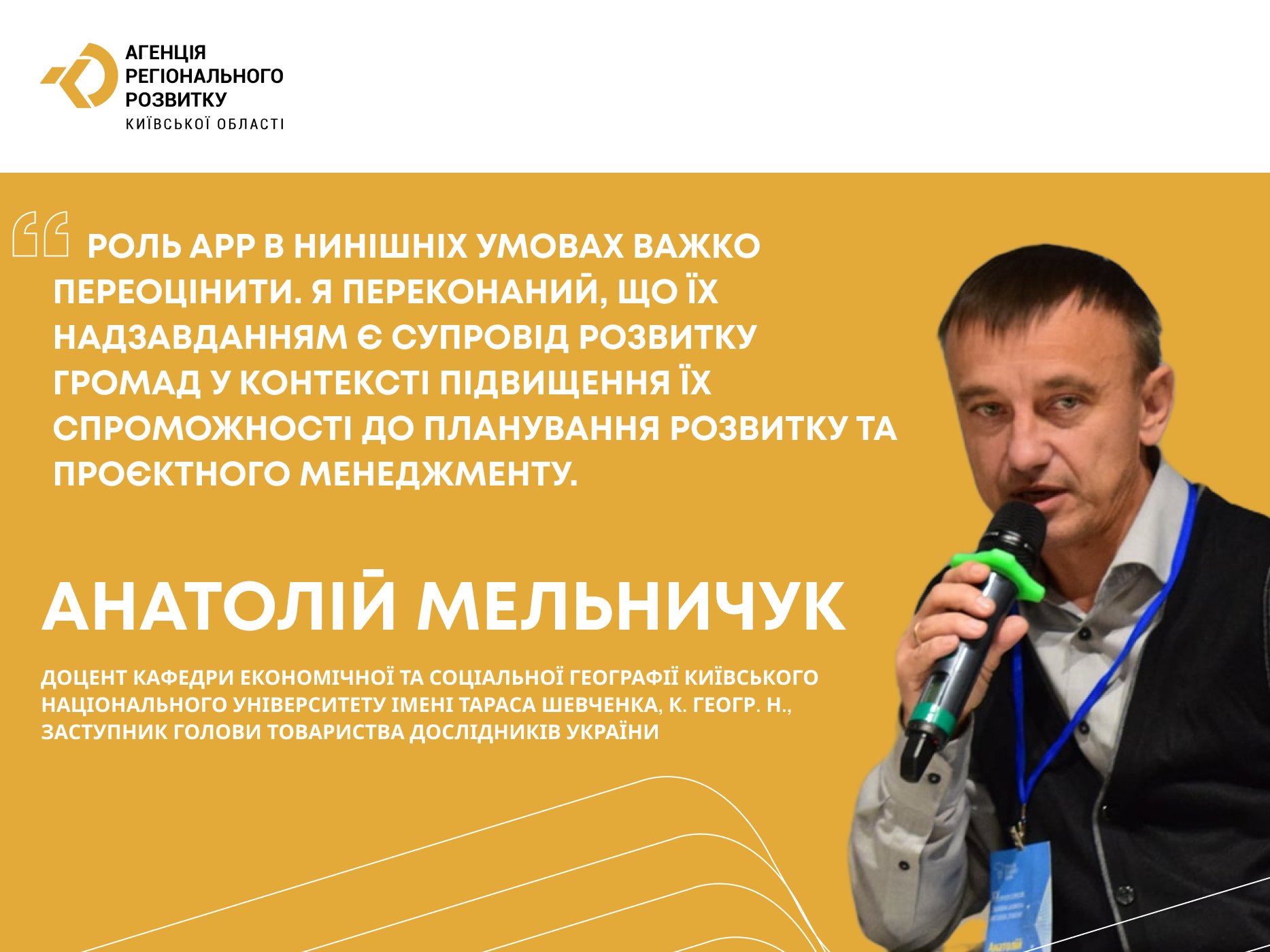
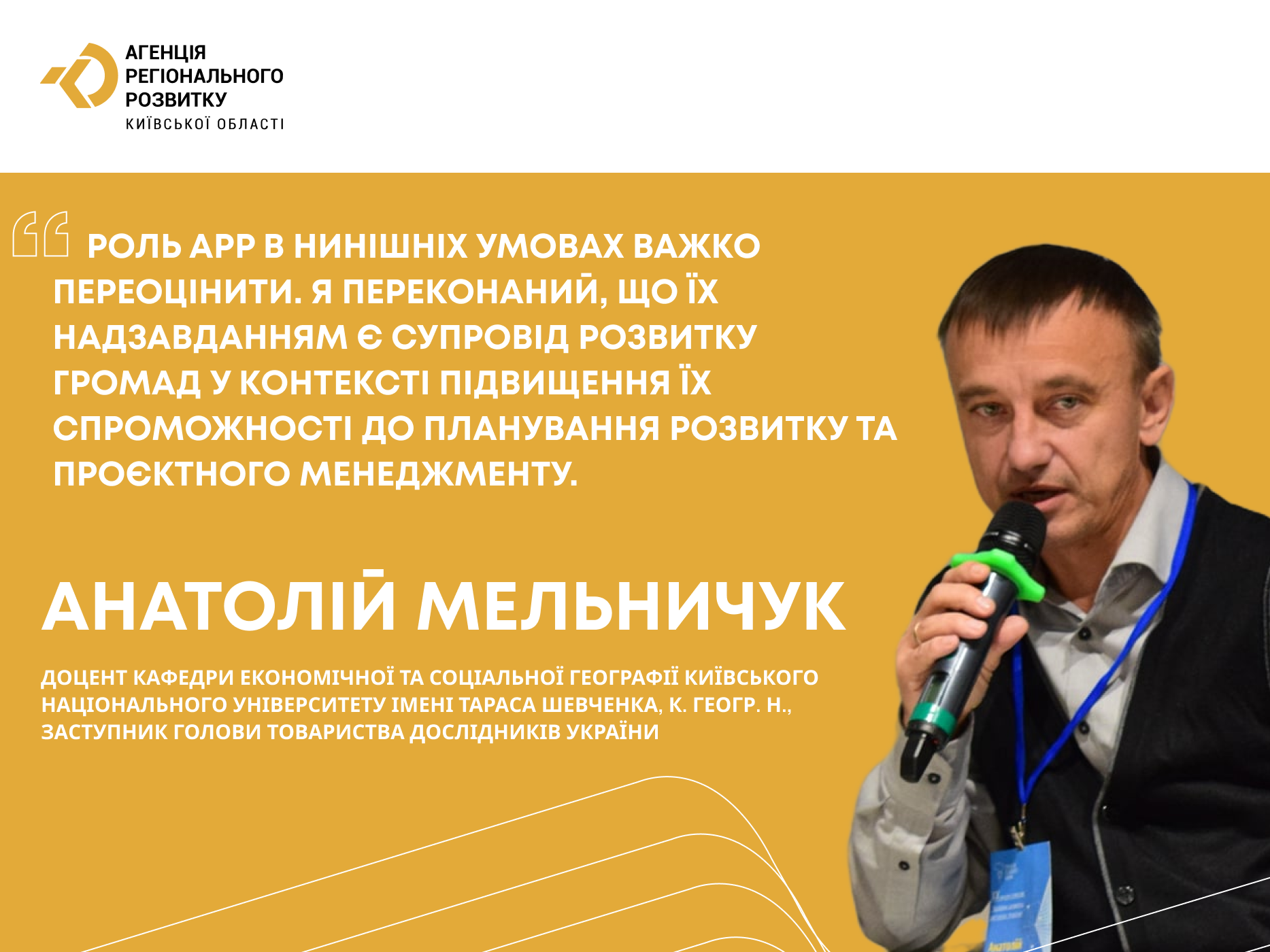
The role of RDAs in the current conditions is difficult to overestimate. I am convinced that their overarching task is to support community development in the context of increasing their capacity for development planning and project management. At a certain stage, they can take on the coordination of forming a reliable statistical base for local development, engage the best global and Ukrainian planners, architects and urbanists in the sustainable recovery and development of the region, ensure the management of key projects, including at the local level, and ensure the coordination of local self-government bodies and business in forming tenders, procurement, developing estimates and providing other support for community development.
What recommendations would you give the Agency to increase the effectiveness of its activities under conditions of war?
I would recommend developing a methodology for forming a statistical basis for providing data for planning and design in the region based on GIS technology for the region's statistical support, forming a database of designers, planners and project organisations and institutions that the region recommends for working with communities, forming a platform of expert advisors — a Council of Experts for the Development of Kyiv Oblast — creating a digital online training platform for local self-government representatives, and forming a communication platform for the main stakeholders of Kyiv Oblast's development.
The recovery of Kyiv Oblast is a joint effort of government, business and civil society. Anatolii Melnychuk emphasises the importance of coordinating efforts and involving the Regional Development Agency in this process, which should become a reliable partner for communities.